
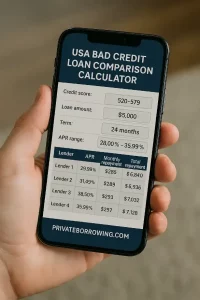
What bad credit means in practice
Bad credit describes a record of missed payments, defaults, court judgments, insolvency or debt collection. Lenders read this record through credit reference agencies or public registers and use it to estimate how likely a new loan is to be repaid on time.
Each country records credit differently. Some use private bureaus that hold positive and negative data, others rely on central bank registers that list only significant debts or defaults. The way information is stored affects how long a problem stays visible.
National credit registers
Common examples include Experian, Equifax and TransUnion in the UK and US, SCHUFA in Germany, the FICP register in France, BKR in the Netherlands, CRIF in Italy, CIBIL in India and Serasa in Brazil, each with its own retention periods.
| Country | Main register or bureau | Typical retention of negative data |
|---|---|---|
| United Kingdom | Experian, Equifax, TransUnion | Six years from default or settlement |
| Germany | SCHUFA | Generally three years after settlement |
| France | FICP (Banque de France) | Up to five years for repayment incidents |
| United States | Equifax, Experian, TransUnion | Seven years for most negative items |
| South Africa | TransUnion, Experian, XDS | Varies; debt review flag until clearance |
Who still lends to people with poor records
Credit unions, community development lenders, secured lenders and some specialist online lenders consider applicants with past problems. They usually look more closely at recent behaviour, stable income and existing debt than at the oldest negative entries.
Thin files are different
A person with no credit history is not the same as someone with bad credit. Thin files can often be improved quickly with small reported products, while bad files require time and consistent repayment to rebuild trust with lenders.
Legitimate options with bad credit
Options differ widely by country, but the following categories exist in most developed credit markets. They are listed broadly from the most protective for borrowers to the most expensive, which is also a sensible order for checking them.
- Free debt advice to review whether a loan is needed at all.
- Credit union loans, often with legal rate caps and flexible criteria.
- Public social loans or benefit advances, interest-free where available.
- Secured loans backed by savings or a vehicle, with careful risk assessment.
- Regulated specialist lenders that price for higher risk.
Costs and legal caps
Many countries cap interest. UK high-cost short-term credit is limited to 0.8 percent per day, US credit union payday alternative loans have a federal rate ceiling and South Africa ties maximum rates to the repo rate. Germany and France apply usury thresholds.
Specialist lenders often charge close to these limits for bad-credit applicants. Comparing the total amount repayable across several regulated providers, rather than the monthly instalment alone, reveals the real difference in cost over the full term.
Borrower rights everywhere
Most legal systems give borrowers a right to see their credit file, correct inaccurate entries and receive clear pre-contract information. Many also give a short withdrawal period and require lenders to treat customers in difficulty fairly.
Benefits and income
Social benefits are counted as income by some lenders and excluded by others. Several countries protect minimum income from seizure, so borrowing against benefits can leave a lender with limited recovery options and the borrower with heavy pressure.
Steps to borrow with bad credit
The following sequence helps find the safest available credit and reduces the chance of repeated refusals, each of which can leave another mark on the file and lower the chances of acceptance with the next lender approached.
- Obtain your credit report from each relevant bureau or register.
- Dispute errors and check whether old entries should have expired.
- Speak to a debt adviser if repayments already feel unmanageable.
- Approach a credit union or community lender before specialist lenders.
- Use soft-search eligibility checks to compare likely offers.
- Choose the lowest total cost and set repayments to match payday.
Red flags for bad-credit borrowers
Fraudsters target people with poor records because refusals elsewhere make them more receptive to promises. Upfront fee scams are the most common, often disguised as insurance, administration or tax payments demanded before release of funds.
- A fee for insurance, administration or tax requested before any money is released.
- Guaranteed approval whatever your credit history or income.
- No licence or registration that can be checked on the national regulator's register.
- First contact through social media, messaging apps or unsolicited texts.
- Pressure to accept within minutes, or requests for online banking passwords.
Repairing credit over time
Negative entries fade in importance as time passes and new positive data accumulates. Paying all current bills on time, keeping card balances low and avoiding frequent applications gradually improve how lenders assess an application, often within one or two years.
When insolvency is better than borrowing
If debts cannot be repaid within a reasonable time, formal solutions such as insolvency procedures or court-approved plans may be more appropriate than new credit. A debt adviser can explain the options available under national law.
Can I get a loan with a default on my file?
Yes, some regulated lenders consider applicants with defaults, especially older ones or those already settled. Expect higher rates, lower amounts and closer income checks, and compare credit unions and community lenders before turning to high-cost specialist providers.
Do private lenders ignore credit history?
Licensed private and online lenders still check credit and affordability in most countries. A lender that claims to ignore your history completely is either relying on collateral or operating outside the law, and both carry higher risk.
How long does bad credit last?
It depends on the register. Negative information is commonly kept for three to seven years, although some public records and insolvency entries follow separate rules. Checking local retention periods helps plan when a new application has a better chance.
Will a secured loan help?
A secured loan can be approved where an unsecured one would not, because the lender holds collateral. The risk is losing the asset, so secured borrowing should be limited to amounts that can clearly be repaid on schedule.
Lenders offering these loans
- Fair Finance — A London-based social enterprise and direct lender offering affordable personal loans of up to £3,000 to people underserved by mainstream credit providers.
- Avant — A US online lender offering unsecured personal loans designed for borrowers with fair or less-than-perfect credit, with an online application and fast funding.
- Upstart — A US online lending platform offering personal loans, including debt consolidation and relief loans, with an online application for a broad range of borrowers.
- London Capital Credit Union — A member-owned UK credit union offering affordable personal loans and savings accounts to people who live or work in its London common bond area.
Useful organisations and resources
- StepChange Debt Charity — Free UK debt advice and formal solutions for over-indebted borrowers.
- ClearScore — Free UK credit report access and explanations of negative entries.
- Cyprus Credit Union — US credit union lending to borrowers with limited or non-traditional histories.
- OurPower debt review guides — South African guides on over-indebtedness and debt review.
Official and legal references
- NCUA payday alternative loans rule summary — US federal limits for credit union small-dollar loans available to members with weak credit.
- South African Supreme Court of Appeal on debt review — Example of case law on over-indebtedness procedures under the National Credit Act.
- StepChange: credit and loans on an IVA — UK guidance on borrowing restrictions during a formal debt solution.