
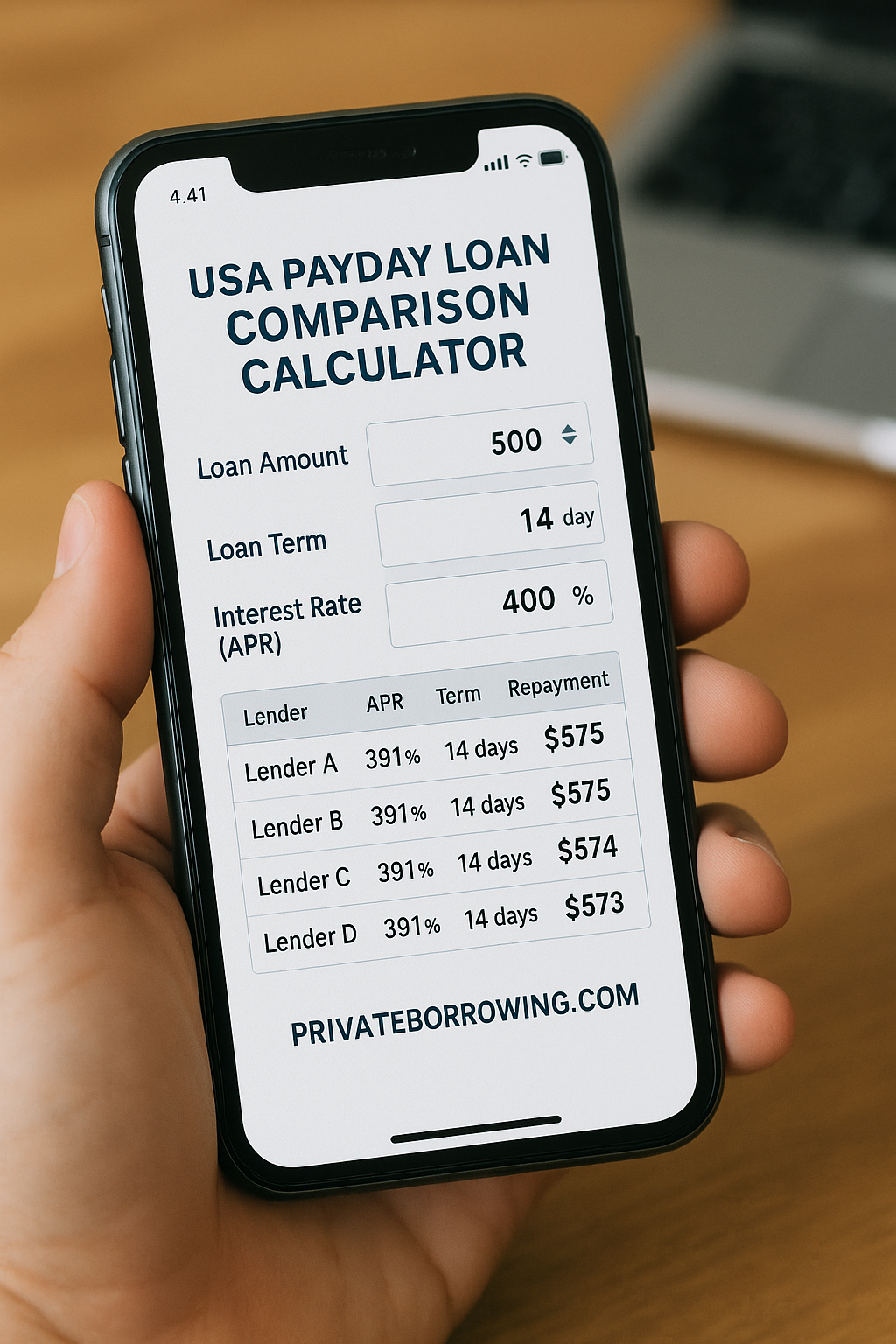
What is a U.S. payday-loan comparison calculator ?
A U.S. payday-loan comparison calculator is a tool for comparing short-term loans by amount borrowed, finance charge, repayment term, annual percentage rate, total repayment and rollover cost. It converts different fee structures and repayment periods into common measures so borrowers can evaluate competing payday-loan offers more consistently.
Why a Calculator Is Useful
Payday loans are usually small, short-term obligations that are repaid in one payment within two to four weeks. Because a flat fee can look modest in dollars while producing a very high annualized cost, a calculator helps borrowers compare offers on a common basis before accepting credit. CFPB payday-loan guidance
The Core Inputs
A useful comparison calculator should ask for the cash actually received, the finance charge, the number of days until repayment, any additional fees, the number of expected rollovers and the amount due at maturity. State, military status and lender identity should also be entered for legal and licensing checks.
The Core Outputs
The calculator should display at least five results: finance charge in dollars, total repayment, fee per one hundred dollars borrowed, estimated annual percentage rate and projected cost after any rollover. A second comparison column should show the same figures for another payday loan or alternative credit product.
Understanding the Loan Amount
The principal is the amount of money the borrower receives and must repay. A calculator should distinguish this figure from the total amount due. If a consumer receives three hundred dollars and owes three hundred forty-five dollars at maturity, the extra forty-five dollars is the finance charge, not additional principal. CFPB cost example
Understanding the Finance Charge
The finance charge represents the dollar cost of obtaining the credit, including charges treated as finance charges under federal disclosure rules. The CFPB notes that payday-loan fees commonly range from ten to thirty dollars for each one hundred dollars borrowed, depending on state law and the specific lender. Official CFPB costs
Fee Per Hundred Dollars
Converting the finance charge into a fee per one hundred dollars makes different loan sizes easier to compare. Divide the finance charge by the principal, then multiply by one hundred. A forty-five-dollar charge on a three-hundred-dollar loan therefore equals fifteen dollars for every one hundred dollars borrowed.
Calculating Total Repayment
Total repayment for a single-payment payday loan is usually principal plus the finance charge and any other required amount included in the contract. A three-hundred-dollar loan carrying a forty-five-dollar finance charge therefore requires three hundred forty-five dollars at maturity, assuming there are no additional lawful charges.
Calculating the APR
For a simple single-payment comparison, an estimated APR can be calculated by dividing the finance charge by the amount borrowed, multiplying by three hundred sixty-five divided by the loan term in days, then multiplying by one hundred. The lender’s disclosed APR remains the controlling figure for the actual contract. CFPB APR explanation
A Typical Two-Week Example
The CFPB uses a common example in which a borrower pays fifteen dollars for each one hundred dollars borrowed for fourteen days. On a three-hundred-dollar loan, the fee is forty-five dollars and the estimated APR is about three hundred ninety-one percent, illustrating how short terms magnify annualized costs.
Why APR Looks So High
APR annualizes the cost of credit so loans with different terms can be compared. A fifteen-percent charge over one full year would be very different from the same percentage charged for only fourteen days. The CFPB therefore recommends focusing on APR when comparing payday loans with other forms of credit.
Comparing Different Loan Terms
A calculator should never compare only the dollar fee when loan terms differ. A sixty-dollar fee on a thirty-day loan may have a lower annualized cost than a forty-five-dollar fee on a fourteen-day loan. Entering the exact number of days makes the comparison more meaningful and avoids misleading conclusions. Regulation Z APR rules
Comparing Two Payday Loans
Suppose Loan A offers three hundred dollars for fourteen days with a forty-five-dollar fee, while Loan B offers the same principal with a thirty-dollar fee. The calculator should show both total repayment and APR, making clear that identical borrowing amounts can carry materially different short-term and annualized costs.
Comparing Different Principal Amounts
When loan amounts differ, absolute fees alone become misleading. A seventy-five-dollar fee on five hundred dollars equals fifteen dollars per hundred, while a sixty-dollar fee on three hundred dollars equals twenty dollars per hundred. Standardizing the fee allows the borrower to see which offer is proportionally more expensive. CFPB fee methodology
Comparing Payday and Installment Credit
A comparison calculator can also place a payday loan beside an installment loan, credit-union alternative or credit card cash advance. Because repayment structures differ, APR and total repayment are more useful than matching monthly or biweekly payments. The borrower should also compare late fees, prepayment terms and required add-ons.
Calculating Rollover Cost
A rollover occurs when the borrower pays a fee to extend the due date instead of repaying the principal. The CFPB gives an example where a three-hundred-dollar loan with a forty-five-dollar charge is rolled over once, raising total fees from forty-five to ninety dollars while the three-hundred-dollar principal remains outstanding. CFPB rollover example
Multiple Rollovers
A calculator should let the user enter the number of rollovers and add each new finance charge separately. If the same forty-five-dollar charge is imposed three times on a three-hundred-dollar principal, cumulative fees become one hundred thirty-five dollars, while the original principal may still remain due at the end.
Rollover Cost Versus Principal
One of the most useful outputs is cumulative fees as a percentage of the original amount borrowed. Paying one hundred thirty-five dollars in charges on a three-hundred-dollar loan means fees equal forty-five percent of the principal. That figure can make repeated extensions easier to understand than an APR alone.
State Law Must Be Checked
Payday lending rules are not uniform across the United States. The CFPB states that some states do not permit payday lending, while others regulate loan amounts, fees and lender licensing. A comparison calculator should therefore ask for the borrower’s state before presenting any offer as legally available or compliant. CFPB state-law guidance
Checking the Lender’s License
The CFPB advises consumers to verify a payday lender with the appropriate state regulator or attorney general. A calculator can include a direct licensing-check link, but it should never label a lender as authorized solely because the company displays a license number or professional-looking badge on its own website. CFPB licence guidance
Using NMLS Consumer Access
NMLS Consumer Access is a searchable public service that provides information about many state-licensed financial companies, branches and individuals. It can be useful where the relevant lender appears in the system, but borrowers should still follow the CFPB’s advice to confirm requirements with their own state regulator.
State Fee Caps Change the Result
Many states that allow payday lending impose limits on the fee, loan size or other contract terms. The CFPB reports that statutory payday fees can range from ten to thirty dollars per one hundred dollars borrowed. A calculator should therefore compare the entered fee with state rules before displaying eligibility.
Federal Disclosure Rules
Federal Truth in Lending Regulation Z requires creditors to disclose important credit costs, including the annual percentage rate where applicable. The CFPB explains that a payday lender must disclose the APR before the borrower agrees to the loan. The calculator should therefore be used to verify understanding, not replace official disclosures.
Why the Lender’s APR Matters
A homemade formula is useful for screening simple single-payment offers, but real contracts may include timing details or charges requiring Regulation Z calculations. If the lender’s disclosed APR differs materially from a simple estimate, the borrower should review the contract carefully and ask how the disclosed figure was calculated.
Bank-Account Withdrawal Risk
Many payday loans require authorization for electronic repayment from a bank, credit-union or prepaid-card account. A comparison tool should therefore include the expected debit date and amount, helping the borrower see whether the account will contain enough money after rent, utilities, food and other essential obligations are paid.
Federal Payment Protections
The CFPB Payday Lending Rule limits certain repeated attempts to withdraw payment from consumers’ accounts and is designed to reduce excessive bank fees and unexpected debits. The Bureau’s current implementation page was updated in June 2026, so borrowers should consult the latest federal guidance before disputing collection activity.
Insufficient-Funds Costs
The real cost of a payday loan can exceed the contractual finance charge when an attempted debit triggers overdraft or nonsufficient-funds fees. A comparison calculator should therefore provide an optional field for estimated bank charges, while clearly separating lender fees from costs imposed by the borrower’s bank or credit union.
Military Borrowers Need a Separate Check
Active-duty servicemembers and certain dependents receive additional federal protections under the Military Lending Act. The CFPB states that covered borrowers generally cannot be charged more than a thirty-six-percent Military Annual Percentage Rate on covered consumer credit, including payday loans, and several contractual practices are also restricted.
MAPR Is Not Always Ordinary APR
The Military Annual Percentage Rate can include finance charges, credit-insurance premiums, add-on credit products and certain application or participation fees. A calculator intended for military users should therefore contain a separate MAPR warning rather than assuming that an ordinary APR calculation alone establishes compliance with the federal thirty-six-percent ceiling.
Alternatives Belong in the Comparison
A responsible calculator should not compare only payday lenders. It should also provide space for credit-union loans, bank small-dollar loans, credit cards, employer advances or payment plans. Even when an alternative takes longer to arrange, its total dollar cost and APR may be substantially lower than short-term payday credit.
Payday Alternative Loans
Federal credit unions can offer qualifying Payday Alternative Loans under National Credit Union Administration rules, and the CFPB recognizes certain PAL structures as alternative loans under its payday-lending regulation. Availability depends on membership and the individual credit union, so the calculator should treat PALs as alternatives rather than guaranteed offers. CFPB PAL guidance
Payment Plans Before Another Loan
Some state laws require payday lenders to offer extended repayment plans in certain circumstances. The CFPB notes that these rules vary by state and may differ on whether a fee is allowed. A calculator should include a repayment-plan comparison whenever the borrower is considering a rollover or a second loan. CFPB repayment-plan guidance
Using the Calculator Before Applying
The safest workflow is to enter the principal, fee and term before submitting an application, then compare at least two alternatives. The borrower should review the resulting APR, total repayment, rollover scenario and cash remaining on the due date, rather than choosing solely on speed of funding or advertised convenience.
Checking Cash Remaining on Payday
A useful affordability field subtracts the full loan repayment from net income on the due date and then subtracts essential bills due before the next paycheck. If the result is negative, the calculator should flag that the loan may create another shortfall even if the borrower can make the payment.
Avoiding Guaranteed-Approval Marketing
A calculator should never rank a lender higher because it promises guaranteed approval, no questions asked or instant cash. The FTC payday-lending resource documents enforcement and consumer concerns involving high-cost lending. Borrowers should verify the company, read disclosures and avoid offers that obscure the true APR or repayment obligation.
Never Pay an Unexplained Advance Fee
If an online lender requests money before releasing the advertised payday loan, the borrower should stop and verify the company. Legitimate credit costs should be disclosed clearly in the agreement. Unexpected requests for release, insurance, processing or verification payments are warning signs that deserve independent regulatory checking before any transfer.
Building the Website Calculator
For a website, the calculator can use editable fields for principal, finance charge, term, rollover count and optional bank fees. Results should update instantly and show dollar cost, fee per hundred dollars, estimated APR, total repayment and rollover total, with a prominent state-law and lender-license verification reminder beside the results.
Adding a Comparison Column
A two-column design lets users enter Loan A and Loan B with the same fields, then highlights lower total repayment and lower APR without calling either product safe. A third column can be reserved for a product, allowing users to compare the payday offer with a credit-union or bank option.
Adding Legal Disclaimers
The tool should state that calculations are estimates, state law varies and lender disclosures control the actual contract. It should also explain that APR comparisons do not determine affordability. Links to the CFPB, the borrower’s state regulator and lender-licensing resources should appear beside the calculated results rather than hidden elsewhere.